
Case Study: AI and the Monstrous Mind
Designing an interdisciplinary writing course on artificial intelligence, ethics, and the boundaries of the human.
AI and the Monstrous Mind asks students to examine artificial intelligence through one of the humanities’ oldest figures: the monster. I designed the course to help students move beyond surface-level debates about technology and into deeper questions about consciousness, labor, ethics, agency, and personhood. Through literature, film, theory, discussion, and analytical writing, students learn to treat AI not only as a tool, but as a cultural object that reveals what societies value, fear, exclude, and create.
Project Type:
Higher education course design; Accelerated online course
Role:
Course Designer, Instructor, Curriculum Developer, Multimedia Designer
Audience:
Undergraduate writing and humanities students
Tools:
Canvas LMS, PlayPosit, Google Workspace, OER materials, multimedia video, AI tools
Core Skills Demonstrated:
Course design, curriculum design, AI literacy, writing instruction, multimedia learning, critical thinking, learner engagement, academic assessment
The Challenge
Artificial intelligence is often framed in technical, commercial, or productivity-driven terms. For undergraduate students, that framing can make AI feel either too abstract, too inevitable, or disconnected from the humanities.
The challenge was to design a writing course that treated AI not only as a tool, but as a cultural and philosophical question. Students needed to practice academic writing, source use, and textual analysis while also examining what artificial intelligence reveals about human systems, social values, power, creativity, and control.
Because the course was delivered in an accelerated format, the learning experience also needed to be structured enough to support momentum without simplifying the complexity of the subject.
Central Design Question:
What does artificial intelligence reveal about the boundaries we draw around the human?
Learning goals
Students in this course develop academic writing and analytical reading skills while engaging difficult questions about ethics, personhood, creation, and responsibility. By the end of the course, students are prepared to:
- Analyze literary, cinematic, theoretical, and cultural texts
- Develop claims supported by textual evidence and scholarly sources
- Synthesize multiple perspectives in academic writing
- Evaluate AI as a cultural, ethical, and rhetorical object
- Reflect on their own choices when working with AI tools
- Connect course concepts to broader questions about humanity, labor, agency, and control
The design approach
I designed the course around a central question: What does artificial intelligence reveal about the boundaries we draw around the human?
The course uses the figure of the monster as a conceptual bridge between familiar humanities conversations and emerging questions about AI. This gave students a way to examine how societies define intelligence, assign value, construct outsiders, and respond to beings or systems that challenge existing categories.
The module sequence moves from foundational concepts to more complex ethical and philosophical questions. Each week builds toward the next, helping students connect readings, films, discussions, research, and writing assignments into a coherent intellectual progression. Rather than treating writing as a separate skill, the course positions writing as the primary method of inquiry.
Design Focus:
AI literacy, academic writing, ethical reasoning, and critical interpretation.
What I Built
For this course, I developed a full Canvas learning environment that included:
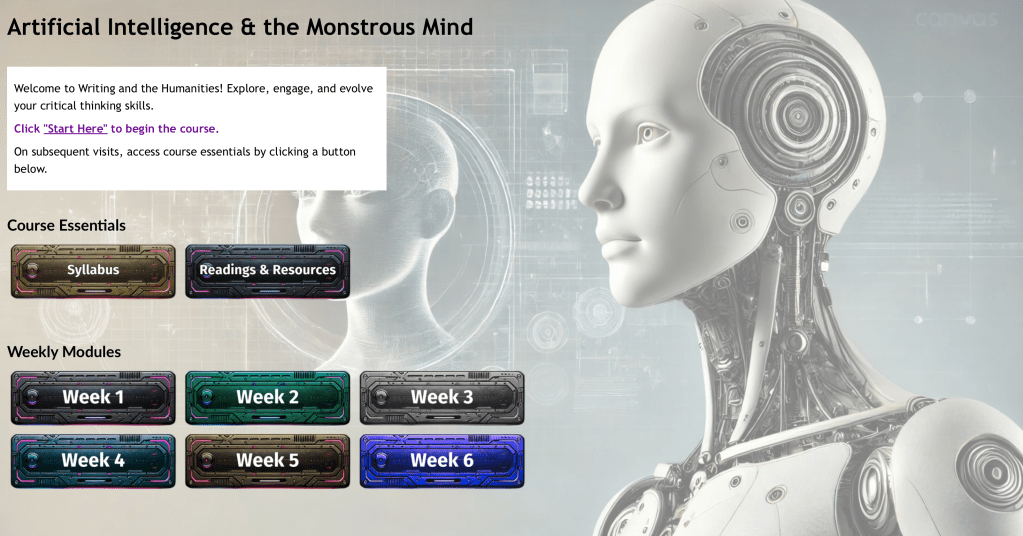
- A custom course homepage and visual identity
- Weekly modules with clear pacing and progression
- Open educational and low-cost course materials
- Multimedia introductions and instructional videos
- PlayPosit-supported video activities
- Reading and discussion prompts
- Low-stakes writing practice
- Major analytical writing assignments
- AI-supported final project work
- Reflection and process-based writing activities
- A structure designed for accelerated delivery
Learning experience design
The course was designed around three connected layers of learning.
First, students build conceptual understanding by exploring artificial intelligence through literature, film, philosophy, and cultural criticism.
Second, they practice academic writing skills through analysis, synthesis, source integration, revision, and reflection.
Third, they apply those skills to questions that extend beyond the classroom: Who gets recognized as intelligent? Who gets treated as human? What responsibilities come with creating artificial minds? What assumptions shape the technologies we build?
This structure allowed students to engage AI as both a course topic and a writing problem. They were not simply asked what they thought about AI. They were asked to develop claims, support interpretations, evaluate evidence, and examine the cultural frameworks behind their assumptions.
AI as learning partner
One of the central applied learning experiences in the course asks students to partner with an AI model to create a work of their own and then write an analytical reflection evaluating both the process and the product.
Applied Learning Moment:
Students partner with an AI model to create a project, then analyze the process, authorship, and limits of what they made.
The assignment requires students to make choices, test prompts, assess outputs, revise direction, and reflect on authorship, agency, collaboration, and control. The goal is not to celebrate or reject AI, but to help students develop more precise judgment about what the model contributes, what the human contributes, where the process breaks down, and what the experience reveals about creativity, labor, and decision-making.
Learner Experience
The course was built to help students feel oriented, supported, and intellectually challenged. Weekly modules used consistent structure so students could focus on the work of reading, writing, and thinking rather than figuring out where to go next.
The visual course homepage, instructional videos, low-stakes assignments, and recurring module patterns helped create a clear path through an accelerated course. At the same time, the readings and assignments asked students to wrestle with ambiguity, interpretation, and ethical complexity.
I also created a course guide character, Erasmo, to welcome students into the class and establish a tone that was thoughtful, slightly strange, and approachable. In an online course about AI, monstrosity, and personhood, this small design choice helped make the learning environment feel more human.
Skills demonstrated
This project demonstrates my ability to:
- Design interdisciplinary learning experiences around complex emerging topics
- Translate abstract concepts into structured learning pathways
- Build online courses in Canvas with clear navigation and module progression
- Create multimedia learning assets that support tone, orientation, and engagement
- Design writing assignments that support analysis, synthesis, and reflection
- Integrate AI tools in ways that support judgment rather than shortcuts
- Develop accessible, student-centered learning experiences for accelerated delivery
- Connect instructional design, humanities teaching, and emerging technology

